

By Kirk at Brushtek · September 9, 2026 · Cabinet painting
Should You Paint or Replace Your Kitchen Cabinets?
The short answer: Paint the cabinets if the boxes are solid, the layout works, and you like the door style or can live with it. Replace them if the particleboard has swelled, the layout is the real problem, or you want different doors. Most 1990s and 2000s oak and maple kitchens in the west metro pass the test and paint well when the grain is filled and the doors are sprayed off the boxes.
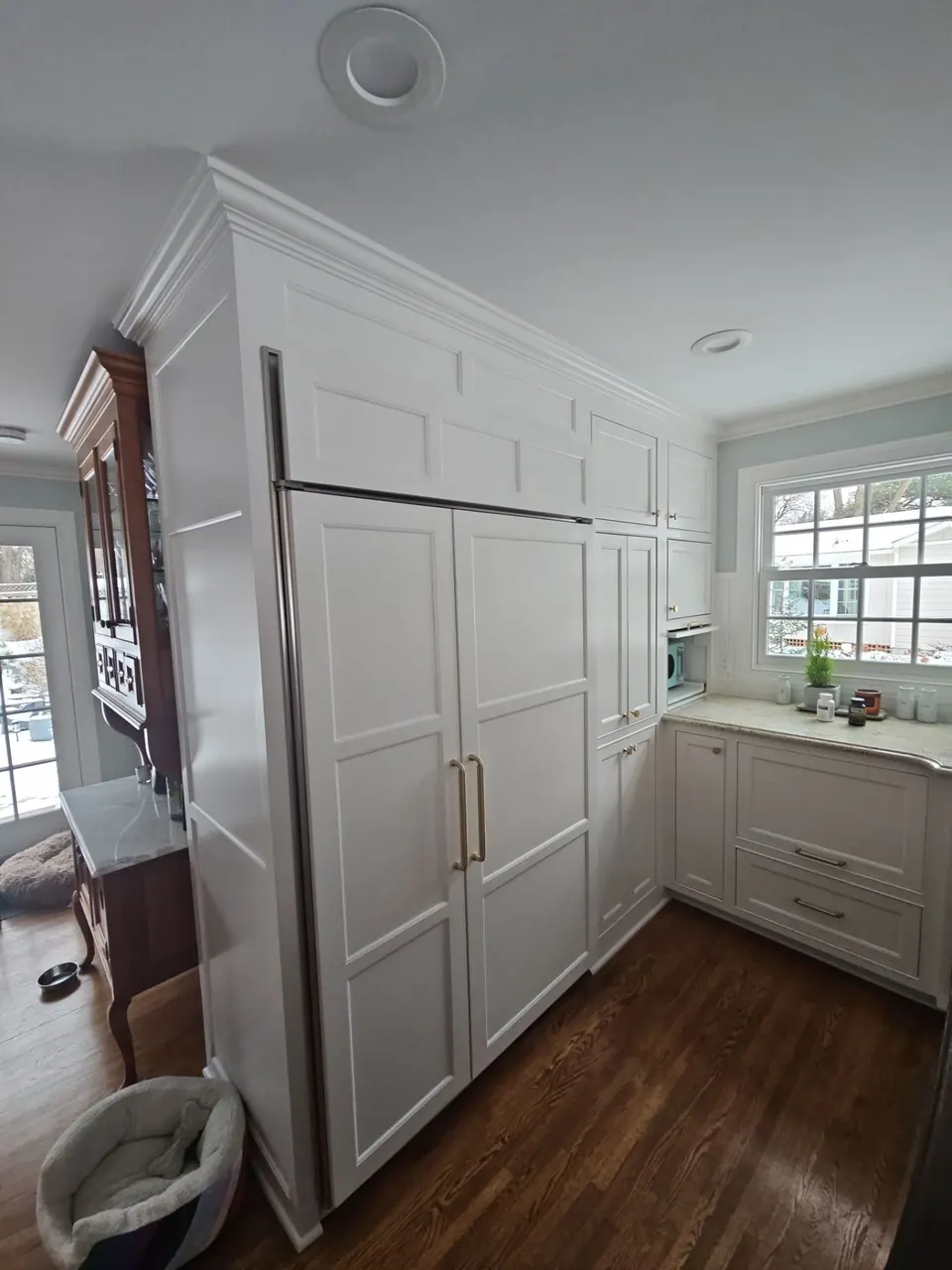
Kitchen cabinets come up constantly in our estimates, and the question is usually some version of whether they can be painted or should just be replaced. The answer is a short inspection, not a matter of taste. Here is the test we run in every kitchen, and what we tell people when the answer is no.
So should you paint the cabinets or replace them?
Paint if the cabinet boxes are sound, the layout works for how you cook, and the doors are a style you like or can live with in a new color. Replace if the boxes are failing, the layout is the problem, or you want a different door profile entirely. Everything else, including the oak grain, the color and the hardware, is solvable with paint.
That is the whole test. The rest of this post is what each part actually looks like in a west-metro kitchen.
Box condition comes first
Open the sink base and look at the floor of the cabinet. Then check the panel beside the dishwasher and the base under the coffee maker. Those three spots take the most water and steam, and they tell you what the boxes are made of and how they have held up.
Plywood boxes and solid-wood face frames, which is what many of the semi-custom kitchens built in the 1990s and 2000s around Medina and Plymouth have, can take a lot of abuse and still be structurally fine. Scratches, water rings, a sagging shelf and a door that has dropped on its hinge are all cosmetic. Paint fixes the first two, and we fix the shelf and the hinge on the way.
Particleboard boxes with a melamine or vinyl skin are the ones to inspect carefully. A little edge wear is fine. Swelling is not.
Particleboard swelling is the deal breaker
When particleboard gets wet it swells and does not go back down. You will see it as a bulge in the floor of the sink cabinet, a bottom edge that has gone soft and crumbly, or a side panel by the dishwasher that has puffed out where the steam hits it. Once the board has swelled, nothing sticks to it and it keeps crumbling. Paint over it looks good for about a month.
If the swelling is confined to one sink base, we can sometimes replace that box or its floor and paint the rest. If it is in three or four places, the kitchen is telling you the boxes are done, and painting them would be spending money on a finish that outlasts what it is sitting on.
The same goes for thermofoil doors, the white vinyl-wrapped MDF doors common in builder kitchens from the late 1990s and early 2000s. When the foil starts peeling at the corners, usually above the dishwasher and beside the range, it cannot be repaired. We can paint thermofoil that is fully intact, but if the peeling has started, new doors on the old boxes is usually the better move.
Paint cannot move a sink
The second part of the test is layout. If the kitchen frustrates you because the dishwasher is on the wrong side of the sink, the refrigerator blocks the doorway, or there is no room for a second person, painting will give you a better-looking version of the same frustration.
Be honest about this before you spend on paint. A fresh color makes a kitchen feel new for a while, and then the layout problem is still there. If the plan is to remodel in two or three years, painting now can still be worth it as a bridge. If the plan is to fix the layout, put the money there.
Door style: what paint changes and what it does not
Paint changes color, sheen and how the grain reads. It does not change the shape of the door. A flat slab door will still be a slab. A raised-panel cathedral-arch door, the one with the curved top rail, will still have the arch.
Some styles paint beautifully: shaker, flat panel, square raised panel, simple slab. The cathedral arch is the one people most often want gone, and paint softens it but does not remove it. If that arch is the thing you cannot stand, the honest option is new doors on the old boxes, painted to match, which costs less than a full replacement and gets you the style you want. We do that combination regularly.
The 1990s oak question
Honey oak was the default kitchen in west-metro two-stories from the late 1980s into the early 2000s, and there are a lot of those kitchens between Plymouth and Buffalo with solid boxes, decent doors and a color nobody wants anymore. These are ideal candidates for painting, with one thing to understand first.
Oak has an open grain. Paint alone will not hide it. If you spray white cabinet enamel straight onto sanded oak, the finish will be smooth to the touch but you will see the grain pattern through it, like a faint topographic map, especially in low-angle light and on the door stiles. Some people like that. Most people who are paying to get rid of the oak look do not.
The fix is grain filling. After cleaning and sanding, we apply a grain filler over the doors and face frames, let it dry, sand it flat, and then prime. It adds a day or more to the job and it is the step that separates a painted-oak kitchen that looks painted from one that looks like it came white from the factory. When we quote oak, we quote the filling, and we will show you a sample door with and without it so you can decide.
Maple, which took over from oak in the 2000s, has a tight grain and does not need filling. It does tend to show sanding scratches through light colors, so it gets finer sanding instead.
The doors-off sprayed process
The way cabinets get painted matters as much as the decision to paint them. Here is our cabinet painting process, which is the same on a 1990s oak kitchen in Wayzata as on a new build.
- Every door and drawer front comes off, and every hinge and pull comes off those. Each piece is numbered so it goes back where it came from.
- Boxes and face frames are cleaned with a degreaser (kitchen grease is the main reason cabinet paint fails), then sanded.
- Oak gets grain filled. All wood gets a bonding primer, which is what lets the enamel stick to a slick factory finish.
- The kitchen is masked: countertops, floors, appliances, the inside of the boxes, and a plastic wall to contain overspray.
- Face frames and box ends are sprayed in place. Doors and drawer fronts are sprayed flat in our setup, both sides, in coats with sanding between, so they come out level with no brush marks.
- Everything cures, gets reinstalled, and the hinges get adjusted so the doors hang square.
Sprayed finish, hardware off, done right. That line is on our own job posts because it is the whole difference. A cabinet job done with a brush and roller on doors still hanging can look acceptable from across the room. It will not look like a factory finish, and it will not wear like one.
How long painted cabinets last
A cabinet enamel applied over proper prep is a hard, washable finish, and with normal use it holds up for many years. The wear points are predictable: the edges of the door under the sink, the trash pull-out, the drawer beside the range. We tell people to be gentle for the first few weeks while the enamel reaches full hardness, and to wipe up spills rather than let them sit. Chips can be touched up.
What shortens the life of a painted kitchen is skipped prep. No degreasing, no bonding primer, no sanding between coats, and the finish starts to peel at the handles within a year. If you get quotes and one is far lower, ask what steps it skips.
When replacement wins
To be direct about it, we tell people to replace rather than paint when the particleboard has swelled in more than one spot, the thermofoil is peeling, the layout is what they actually dislike, the doors are a style paint cannot fix and they do not want new doors, or the kitchen is going to be gutted within a couple of years anyway. Painting in any of those cases is money spent on a finish that will outlive its reason.
Everywhere else, and that is most of the oak and maple kitchens in this part of the metro, painting is the right call.
If you want a straight answer on your own kitchen, a few photos of the doors, the sink base and the dishwasher panel sent through our contact page will let us tell you which side of the test it lands on.
Want us to look at your project?
Text a few photos and tell us what you are after. Written estimate, usually within one business day.
Related questionsStraight answers.
Is it cheaper to paint your kitchen cabinets or replace them?
Painting costs a fraction of replacement, because the boxes, countertops, plumbing and appliances all stay where they are and the only work is finish work. Replacement means new cabinets plus demolition, often new counters, and a kitchen out of service for weeks. Painting makes sense when the boxes are sound. When they are not, replacement is the better spend.
Is professional cabinet painting worth it?
When the doors come off and get sprayed, yes. A professional job means degreasing, sanding, grain filling on oak, a bonding primer, and a cabinet enamel sprayed on, which produces a finish close to factory. A brush-and-roller job on doors still hanging is what gives cabinet painting a bad name, and it is the version that peels at the handles.
How long does cabinet resurfacing last?
A sprayed cabinet enamel over proper prep holds up for many years of normal use. The wear shows first at the sink base, the trash pull-out and the drawer beside the range, and chips there can be touched up. Skipped prep shortens the life: no degreaser, no bonding primer, and the finish starts lifting within a year or two.
Does painting cabinets devalue a home?
Not when it is done well. Buyers generally prefer a light kitchen to dated oak, and a sprayed factory-style finish reads as an update, not a cover-up. What hurts value is a rough job with brush marks and drips, because a buyer prices in fixing it. The quality of the finish is the whole question.