

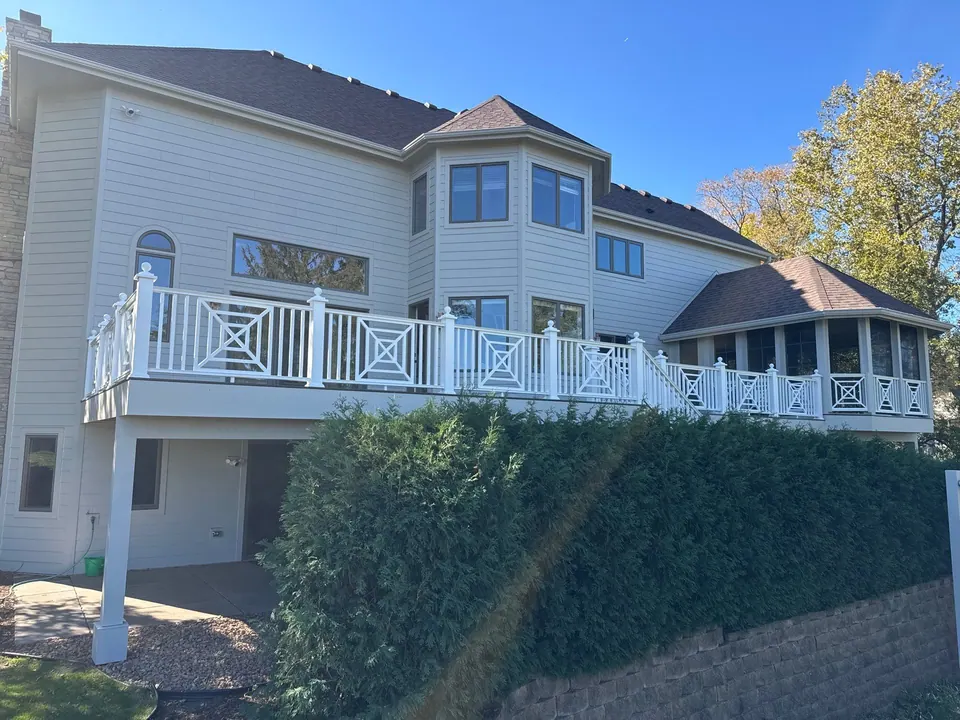
Stain or paint: what holds up on a Minnesota deck
For deck boards you walk on, we lean toward stain. Semi-transparent stain soaks into the wood, wears by fading rather than peeling, and can be recoated without stripping. Solid stain covers like paint but still penetrates, which makes it the right choice for older grey decks and for railings and fences where you want one clean color. Paint sits on top of the wood as a film, and on a horizontal surface that holds snow and puddles, that film eventually lifts. So paint goes on vertical surfaces, spindles and pergolas, or on a deck that has already been painted and cannot go back to stain without a full strip. If a deck has a failing solid coating, we tell you what it will take to get it sound before anything goes on.
- Semi-transparent stain on deck boards: fades instead of peeling, easy to recoat
- Solid stain on grey decks, railings and fences
- Paint on verticals and on decks that are already painted
Moisture readings, rain windows and why timing decides the job
Wood has to be dry to take a finish, and in Minnesota that is a moving target. After a wash, or after a rain, deck boards can read well above where a stain will penetrate, especially on the shaded side and near the house. We meter the boards in several spots and wait until they are down to a level the product will accept, which is often two full sunny days after washing. Then we need a window: no rain for a day after application for most stains, longer for film-forming paints, and no dew-heavy night right after a coat. Spring is tempting but the wood is still wet from thaw, and late fall gets cold nights that stop the finish from curing. June through September is the honest season for outdoor wood.
Fences, railings, pergolas and the lakeside deck
Fences are a lot of surface with a lot of edges, and a sprayed solid stain with back-brushing is the practical way to cover them evenly. Railings and spindles are slow, careful work by brush and are often the part of a deck that looks worst because they take sun from every side. Pergolas and privacy screens are up high and take the weather like a roof. Lakeside decks, which we see a lot of around Lake Minnetonka and the Wright County lakes, get more UV from reflection off the water and more moisture from the lake side, so they need recoating more often than a deck in a shaded backyard. We say that plainly when we quote a lake deck rather than promise it will last as long as one in the shade.
Minnesota has two painting seasons
Exterior season runs roughly May to mid-October. Interior work runs all year.
Exterior paint wants the wall and the air above 50°F for a couple of days. Around here that is roughly May through mid-October, and low-temperature products stretch the shoulders. The other months are interior season: walls, trim, cabinets and built-ins.
Navy = exterior window · paper = interior season
When we would talk you out of it
- A deck with soft, rotten or split boards and loose railings. Fix the structure first, replace the bad boards, and let new pressure-treated wood weather a season before it takes a stain.
- Composite decking. It does not take stain and most of it should not be painted. A good wash is the answer; we will tell you if yours is one of the few that can be coated.
- Staining in April or late October. The wood is too wet in spring and the nights are too cold in fall. We would rather book you for June than put a finish on that fails by winter.
What you get
- Moisture meter readings before any finish goes on
- Wash, dry and brighten so the stain penetrates evenly
- Stain or paint chosen by surface, not by habit
- Rain and dew windows watched before we start a coat
- Railings and spindles brushed, fences sprayed and back-brushed
- Honest recoat expectations for sun-facing and lake-facing decks
How it goes
- 1
Photos of the deck and its current finish
Send a photo of the boards, the railing and any peeling. We can tell a previously stained deck from a painted one and quote the right prep before we visit.
- 2
Wash, brighten, repair, dry
Deck is cleaned and brightened, loose boards refastened, raised grain sanded. Then it dries for as many days as the moisture meter says it needs, usually two sunny ones.
- 3
Wait for the window
We watch for a stretch with no rain in the forecast for a day after each coat and no heavy dew that night. Coats go on in the morning so they set before evening.
- 4
Stain or paint, then walk it
Boards get stain worked in with the grain. Railings are brushed, fences sprayed and back-brushed. We walk the deck with you and note when the first recoat is likely due.
What does it cost to stain or paint a deck?
Deck and fence work is quoted from photos and a look at the wood, and the number tracks surface area, how much railing and spindle work there is, and what has to happen before the finish goes on. A deck with sound boards and a faded semi-transparent stain needs a wash, a dry period and one or two coats. A deck with a peeling solid coating needs stripping or heavy sanding first, which is often the largest line on the estimate. Railings and spindles are slow by hand and cost more per foot than the floor. Fences are priced by linear footage and height. Lakeside decks and south-facing decks are not more expensive to coat, but they need it more often, and we say so.
- Deck floor area and fence linear footage
- Railings, spindles, stairs and pergolas to brush
- Current finish: bare, stained, or a peeling coating to strip
- Stain type: semi-transparent, solid, or paint
- Drying days needed after washing
- Access, height and lake or slope exposure
Questions we get on the phoneStraight answers.
What if it rains 3 hours after I stain my deck?
Most penetrating stains need a rain-free day to set, so a soaking three hours in usually leaves blotches, water spots or a milky film where the water pooled. Light drizzle on a stain that had a couple of hours in the sun often dries out fine. If it looks uneven once dry, a light scrub and a second thin coat usually fixes it.
How late is too late to stain a deck?
Once overnight lows are dropping toward the 40s and the boards stay damp from dew until noon, the season is over for this year, which in the west metro is usually the end of September or early October. Stain applied to cold, dewy wood does not penetrate or cure. We would rather book June.
Should I paint or stain my deck?
Stain, for the boards you walk on, because it wears by fading and can be recoated without stripping. Paint forms a film that eventually lifts where snow and puddles sit. Paint or solid stain makes sense on railings, spindles and fences, and on a deck that has already been painted and would need a full strip to go back.
How long after pressure washing can you stain a deck?
Usually two full sunny days, and we confirm with a moisture meter rather than by the calendar. Boards near the house and on the shaded side hold water longest. Staining too soon traps moisture under the finish and it peels or turns cloudy. A humid week or a north-facing deck can stretch the wait to three or four days.
Related
Where we do this work
Deck and fence across Independence, Medina, Corcoran, Orono, Wayzata, Plymouth, Maple Grove and Minnetonka, and the rest of the west metro and Central Minnesota. See the full service area.