

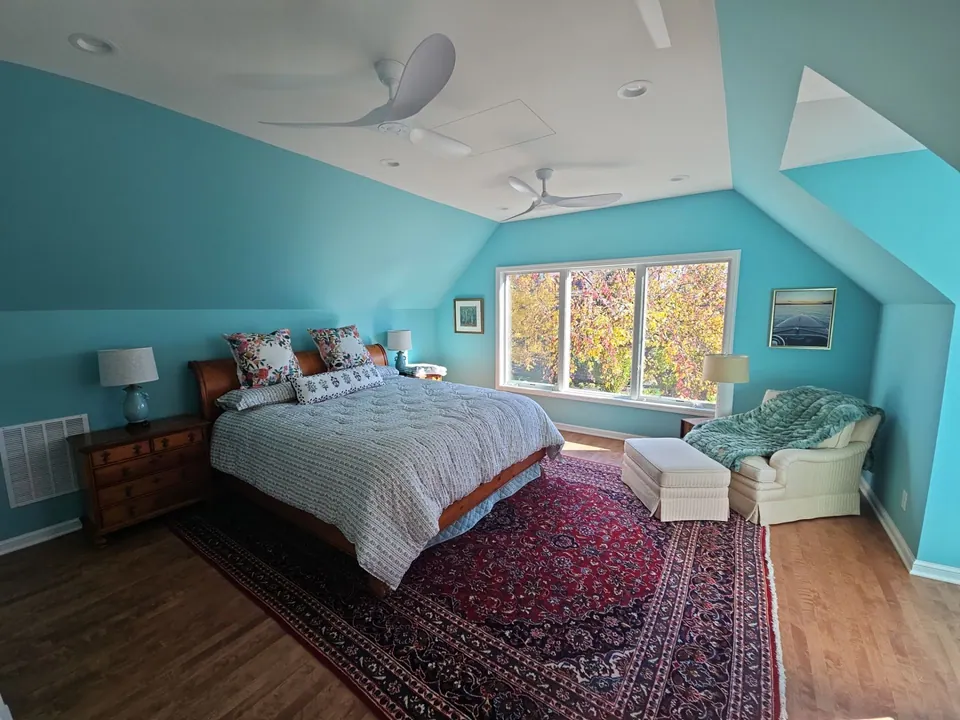
How the consultation works: samples on the wall, not chips
We start by asking what the room is for and what is not changing: floors, tile, countertops, cabinets, big furniture, the trim color. Those things set the temperature of the palette. Then we bring it down to a short list rather than a fan deck, because forty options is how people end up frozen. We paint sample squares about two feet across on the walls the color will actually live on, in the sheen you will use, and leave them for a day or two. Colors shift between morning and evening and between a sunny day and a grey one, and a sample on the wall shows you that. Chips taped to the wall do not. Once you pick, we write the color and sheen for each room on the estimate.
- Inventory what stays: floors, cabinets, tile, trim, furniture
- Two or three candidates, not forty
- Large samples on the real walls, in the real sheen, checked over a day or two
Minnesota light: north rooms, snow glare and lake reflection
Light here is a bigger factor than most color advice from national sources accounts for. Our winter sun is low and warm, our summer sun is high and bright, and for four months there is snow on the ground bouncing blue-white light up through every window. North-facing rooms get cool, flat light all year, so a grey that looked warm in the store reads blue on that wall. South rooms flip in the other direction and can push a pale yellow to gold. Lake homes on Minnetonka, Waconia and the smaller lakes get reflected light off the water that changes with the wind. None of this means a color is wrong. It means you should see it on your wall before you buy nine gallons of it.
Working with what stays: oak floors, tile, cabinets and siding
The most common color mistake we see is picking a wall color in isolation. Honey oak floors and trim, still common in west-metro houses from the 1990s, have a strong orange undertone, and a cool grey next to them makes both look worse. A warm greige or a soft white with a touch of yellow makes the oak look intentional. Bathroom and kitchen tile does the same thing with its own undertones. On the outside, roof color, brick, stone and the neighbor's house all sit next to your siding color, and a color that looks good on a paint card can fight a brown roof. We bring the samples outside, hold them against the trim and the roof, and look from the street.
When we would talk you out of it
- A full interior design plan with furniture, window treatments and lighting. We help with paint. For a whole-room design, an interior designer is the right call and we work well alongside one.
- A homeowner who already knows the exact color. Skip the consultation and we will sample it on the wall to confirm before we order, which is part of any paint job with us.
- Historic color matching for a period restoration. That is a specialist's research project. We can match an existing color on a wall, but not reconstruct a 1920s palette from records.
What you get
- Short list of two or three colors instead of a fan deck
- Samples painted on the real walls in the real sheen
- Colors checked in morning, evening and lamp light
- Undertones matched to oak floors, tile and cabinets that stay
- Exterior colors held against the roof, brick and trim from the street
- Color and sheen written per room on the estimate
How it goes
- 1
Photos of the rooms and what stays
Send photos in daylight that show the floors, trim, cabinets and any large furniture. Tell us which direction the main windows face. That is enough to start narrowing.
- 2
Short list and sample squares
We bring two or three candidates and paint large samples on the walls the color will live on, in the sheen you will use. Exterior samples go on the siding near the trim.
- 3
Live with them for a day or two
Look at the samples in the morning, at dusk and with the lamps on. Snow, rain and sun all change them. Pick the one that looks right most of the day rather than only at noon.
- 4
Lock it and write it down
The color and sheen for each room go on the written estimate. Leftover paint gets labeled the same way so the next touch-up is a match.
How much does a color consultation cost?
When you are booking painting with us, the color help described here is part of the job and is included in the estimate. We sample colors on the wall for every project because a wrong color costs us a repaint too. If you want color help without a painting project, ask when you request an estimate and we will tell you what we can do. What changes the effort is the number of rooms, how many surfaces are involved (walls, trim, ceilings, cabinets), and how many rounds of samples it takes to settle. Exterior consultations take longer because the samples have to be seen at different times of day from the street.
- Number of rooms and surfaces getting new color
- Interior, exterior or both
- Rounds of samples before a decision
- Fixed elements to work around: oak, tile, brick, roof
- Part of a painting project or standalone
Questions we get on the phoneStraight answers.
Who can help me pick paint colors?
Your painter, an interior designer, or the color desk at a paint store, in rough order of how much they know about your actual walls. We help with color on every job because we are the ones who have to repaint it if it is wrong. The useful test is whether they put samples on your wall or hand you a chip.
Where can I get a free paint color consultation?
Paint stores often offer basic color help at the counter. With us, color help is built into every painting estimate, which is free, and includes samples on your walls. If you want color advice without booking painting, ask when you reach out and we will tell you what we can do for your situation.
Why does my paint color look different on the wall than on the chip?
Because a chip is tiny, lit by store fluorescents, and surrounded by white. On a full wall the color is bigger, lit by your windows, and sitting next to your floors and trim. Undertones that were invisible on the chip take over. Painting a large sample on the wall and looking at it over a day is the only reliable test.
What color goes with oak trim and oak floors?
Warm neutrals: a greige with a yellow or red undertone, a soft warm white, or muted greens and blues that sit opposite orange on the wheel. Cool greys fight the orange in oak and make both look off. If the plan is to paint the oak trim white, the wall palette opens up considerably.
Related
Where we do this work
Color help across Independence, Medina, Corcoran, Orono, Wayzata, Plymouth, Maple Grove and Minnetonka, and the rest of the west metro and Central Minnesota. See the full service area.