

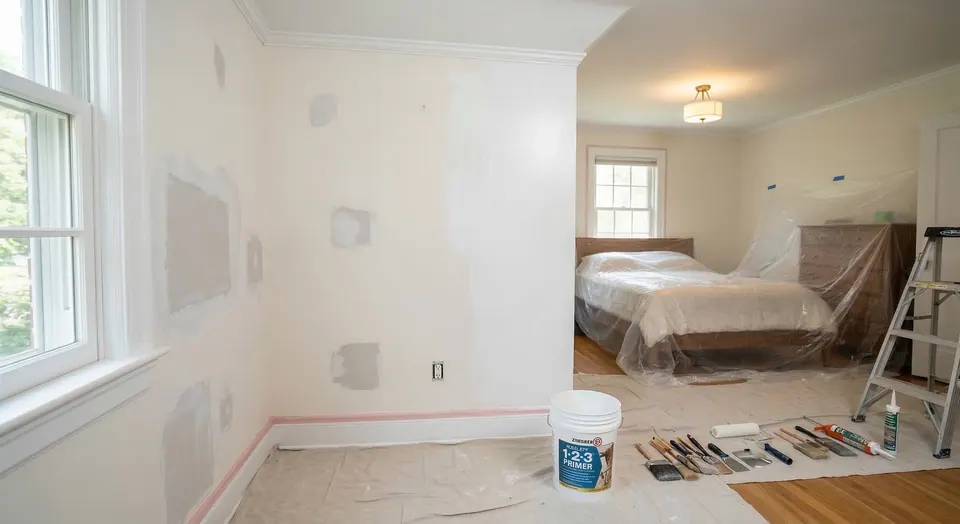
Nail pops, anchor holes and the crack that comes back every winter
Most of what we repair is ordinary wear: TV mount holes, shelf anchors, doorknob dents, the trail of pinholes from a gallery wall. Nail pops are the other regular, and they are a Minnesota thing. Framing lumber dries and shrinks over the first few winters in a new house, the fastener stays put, and a small dome appears in the paint. We drive the screw home, add a second one beside it, fill and sand. Cracks above door and window corners and along the ceiling line open and close with the seasons as the house moves in the cold. Filling those with ordinary compound means they return in January. We tape them with mesh or paper, feather the compound out wide, and they stay closed.
- Anchor and mount holes filled and sanded flush
- Nail pops refastened, then filled
- Seasonal corner and ceiling cracks retaped instead of filled
Patches, texture matching and why a patch flashes
A hole bigger than a golf ball gets a real patch: a backer or a cut-in piece of drywall, tape, and three coats of compound feathered out past the edges. On a textured wall or a knockdown ceiling, we match the texture after the patch cures, which is its own skill and the reason a patch on a ceiling can look obvious even when it is flat. The other reason patches show is flashing. Bare compound absorbs paint differently from the painted wall around it, so a patch painted without primer reads as a dull spot in the sheen. Every repair we make gets a coat of primer before the wall color goes on. On walls with a lot of patches, we prime the whole wall so the sheen is one piece.
How long a patch needs to dry before paint
Compound has to be dry all the way through before it is sanded and primed, and the time depends on the season. In a winter house with the furnace running, a thin skim can be ready in a few hours and a thick patch overnight. In a humid July, the same patch can take a day or more, and painting it early traps moisture that shows up later as a bubble or a crack. We check by color and feel: dry compound is uniformly white and chalky, damp compound is grey and cool. Setting-type compound speeds this up for thick repairs and is what we use when we need to patch and paint in one visit. Either way, primer follows the sanding, and paint follows the primer.
When we would talk you out of it
- Water-damaged drywall that is soft, sagging or moldy. That board has to come out and be replaced, and the leak has to be fixed first. We can paint the new board once it is in.
- Whole rooms of damaged or missing drywall, as in a remodel or a finished basement. That is a drywall contractor's job; we are happy to follow behind them.
- Plaster walls in older homes with widespread cracking. Plaster repair is its own trade. We can handle small cracks, but a failing plaster ceiling needs a specialist.
What you get
- Repairs done by the same crew that paints, so nothing is missed between trades
- Nail pops refastened instead of filled and forgotten
- Seasonal cracks taped so they stay closed
- Texture matched on knockdown and orange peel walls
- Every repair primed so it does not flash under the finish coat
- Dust controlled with sanding sponges and vacuum sanders
How it goes
- 1
Walk the walls with a light
We run a raking light across every wall and ceiling before we quote so the estimate counts the real number of holes, pops and cracks, not the ones you noticed.
- 2
Fill, patch and retape
Small holes get filled, larger ones get a backed patch and three feathered coats, cracks get taped. Nail pops are refastened first so they do not return.
- 3
Dry, sand and match texture
Compound dries fully, then gets sanded flush with the wall. Textured surfaces get a matched spray or knockdown so the repair disappears in the pattern.
- 4
Prime the repairs, then paint
Every repair gets primer so the sheen is even across the wall. Walls with many patches are primed edge to edge. Then two coats of the wall color.
How much does drywall repair before painting cost?
Repair is priced by the number and size of the fixes and by how much texture matching is involved, then added to the painting estimate. A wall with a dozen anchor holes and two nail pops is a small line item. A room with seasonal cracks at every corner takes more time because taping and feathering means several thin coats over two days. Large patches and ceiling texture matching are the expensive end, since the patch has to disappear in the pattern. Doing repairs with the painting is far cheaper than a separate visit, because the drying time overlaps with prep in other rooms. We quote from photos when the damage is clear and from a walkthrough when it is not.
- Number of holes, dents and nail pops
- Size of patches and whether they need backing
- Cracks that need taping rather than filling
- Texture matching on walls or ceilings
- Drying time in the current season
- Repair combined with a paint job or as a standalone visit
Questions we get on the phoneStraight answers.
How long should a drywall patch dry before painting?
Until it is uniformly white and chalky all the way through, which is a few hours for a thin skim in a dry winter house and a day or more for a thick patch in humid summer air. Then it gets sanded and primed. Painting over compound that is still grey in the middle traps moisture and the patch fails later.
Can you paint directly over a drywall patch?
You can, and it will show. Bare compound soaks up paint differently from the wall around it, so the patch reads as a dull spot in the sheen, especially in eggshell or satin with light coming across the wall. A coat of primer over the sanded patch is what makes it disappear. We prime every repair we make.
Should you prime drywall repairs before painting?
Yes, every time. Primer seals the compound so it absorbs the finish coat at the same rate as the surrounding wall, which keeps the sheen even. On a wall with many patches we prime the whole wall rather than spotting each one, since spot priming can itself leave faint halos in some sheens.
Why do the same cracks keep coming back?
Because the house moves with the seasons and the crack was filled rather than taped. Compound alone has no strength across a moving joint. A strip of paper or mesh tape over the crack, feathered out with several thin coats, bridges the movement and stays closed. Cracks that reopen wide every winter may point at a framing or truss issue worth a look.
Related
Where we do this work
Drywall repair across Independence, Medina, Corcoran, Orono, Wayzata, Plymouth, Maple Grove and Minnetonka, and the rest of the west metro and Central Minnesota. See the full service area.