

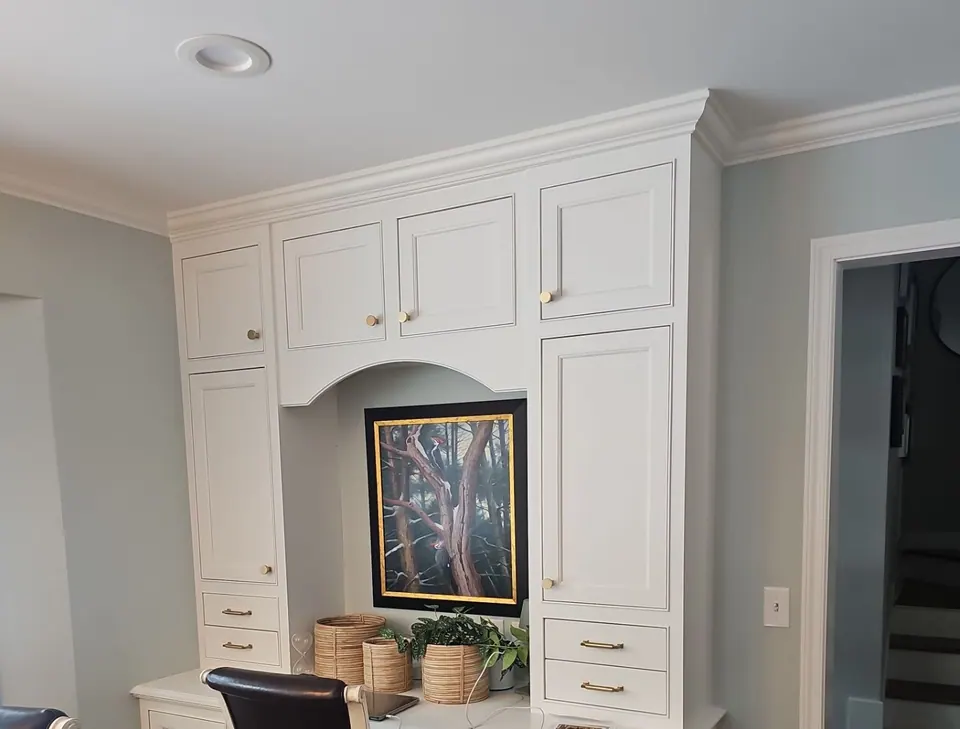
Cut lines by brush, and why we do not rely on tape
The line where the wall meets the ceiling or the trim is where a paint job gets judged. Tape helps on long straight runs, but on textured ceilings and older trim it bleeds, and pulling it can lift the new paint with it. We cut those lines with a brush and a steady hand, then roll up to them so the roller texture carries right to the edge. Corners get the same treatment so you do not see a brushed stripe next to a rolled field. On knockdown ceilings, which are common in west-metro homes from the 1990s and 2000s, a brushed line is the only way to get a clean edge without a ridge of caulk. It is slower than tape. It is also the difference you notice from the couch.
Picking a sheen the room can actually live with
Sheen is a durability choice before it is a look. Flat hides drywall flaws and roller texture but scuffs easily and does not wipe clean, so we use it on ceilings and low-traffic adult bedrooms. Eggshell is the workhorse for living rooms, hallways and kids' rooms because it takes a damp cloth without burnishing. Satin goes in mudrooms, laundry rooms and bathrooms where walls get wet or wiped a lot. Higher sheen shows more of what is under it, so a wall with a lot of old patches wants eggshell rather than satin unless we skim it first. We talk this through at the walkthrough and write the sheen per room on the estimate so there is no surprise on day one.
- Flat: ceilings and quiet bedrooms, hides flaws, does not wipe
- Eggshell: living rooms, halls, kids' rooms, wipeable
- Satin: baths, laundry, mudrooms, holds up to moisture
Builder flat, dark colors and hallway scuffs
Three wall situations come up over and over around here. First is builder flat, the thin white paint most tract and semi-custom homes are handed over with. It absorbs unevenly, so touch-ups flash and the only fix is a full coat, sometimes with a primer under it. Second is a dark or saturated color going lighter, or the reverse. Either direction takes two coats and often a tinted primer to get true color without a third coat. Third is the stairwell and hallway wall that has taken ten years of backpacks and dog tails. Those get washed, spot sanded, primed where the old paint has burnished, and finished in eggshell so the next ten years wipe off. None of this is exotic. It just has to be planned for in the estimate.
When we would talk you out of it
- Walls with active water staining or bubbling paint. Stop the water and dry the wall first. We can prime the stain afterward, but paint over a wet wall will fail.
- A wall where the real problem is cracked or failing drywall tape. That is a repair job first; see our drywall repair page for how we handle it.
- Wallpaper you want painted over. Sometimes it can be done, usually it cannot. Removal is a separate job and we will tell you which one you have.
What you get
- Every wall checked with a raking light before paint
- Cut lines brushed at ceilings, corners and casings
- Two coats on any color change, written into the estimate
- Sheen chosen per room for wear as well as looks
- Floors and furniture masked and covered, then put back
- Leftover paint labeled by room for your own touch-ups
How it goes
- 1
Photos or a walkthrough
Send photos for a first read, or we come out and measure. You get a written estimate that names each wall area, the sheen and the number of coats.
- 2
Colors sampled on the wall
We paint sample patches on the actual wall and let you see them in daylight and lamp light before we buy the full order. No guessing from a two-inch chip.
- 3
Prep and first coat
Furniture centered and covered, floors masked, holes filled, patches sanded and primed. Then cut lines by brush and the first coat rolled in overlapping passes.
- 4
Second coat and walkthrough
Second coat once the first has cured, then a walkthrough with you under good light. Anything you point at gets touched up before we pack out.
What does it cost to have walls painted?
We quote from photos for a range and from a walkthrough for a firm number. Wall painting is priced by the time it takes, and time comes from area, ceiling height, how much cutting there is, and prep. A room with a lot of windows and doors has less wall to roll but more edge to cut, so it is not always cheaper. A color change is two coats; a refresh in the same color can sometimes be one. Dark colors and builder flat both push toward a primer coat. Furnished rooms take longer than empty ones. The estimate is free, written, and broken out by room so you can drop or add spaces before we start.
- Total wall area and ceiling height
- Amount of trim, windows and doors to cut around
- Color change (two coats) versus same-color refresh
- Primer needed for dark colors, stains or builder flat
- Patching and sanding before paint
- Furnished versus empty rooms
Questions we get on the phoneStraight answers.
How many coats of paint do walls need?
Two, on nearly every color change. One coat can look fine wet and then show roller texture and thin spots as it dries, especially with a lighter color over a darker one. A same-color refresh on a wall in good shape is the one case where a single coat can be honest. We write the coat count on the estimate so you know which you are getting.
Should walls be washed before painting?
Kitchens, bathrooms and anywhere hands touch, yes. Grease, soap film and fingerprints keep paint from bonding, and the failure shows up as peeling a year later. Most bedroom and living room walls need dusting and a spot wash rather than a full scrub. We check each wall and clean what needs it as part of prep.
Can you paint walls while I am living in the house?
Yes, and most of our jobs are in occupied homes. We work one or two rooms at a time so the rest of the house stays usable, cover everything in the room, and vacuum before we leave for the day. Low-odor paint keeps the smell down in winter with the windows closed. Pets are the one thing we ask you to keep out of the work zone.
What sheen should I use on walls?
Eggshell for most living areas, satin where walls get wet or wiped often, flat only where you want to hide flaws and nobody touches the wall. Higher sheen shows more imperfections and wipes cleaner; lower sheen hides more and scuffs easier. We recommend a sheen per room at the walkthrough based on how the room is used.
Related
Where we do this work
Wall painting across Independence, Medina, Corcoran, Orono, Wayzata, Plymouth, Maple Grove and Minnetonka, and the rest of the west metro and Central Minnesota. See the full service area.